
WHEN GROUPS STOP BEING ALIVE
Organizations & Organisms - What are you?

In the 1988 cult sci-fi film ‘They Live’, the protagonist finds a special pair of sunglasses that lets him see the true messages hidden behind advertising signs, billboards, TV and other media. Instead of a beautiful woman holding a product on a billboard he sees a message like “CONSUME”.
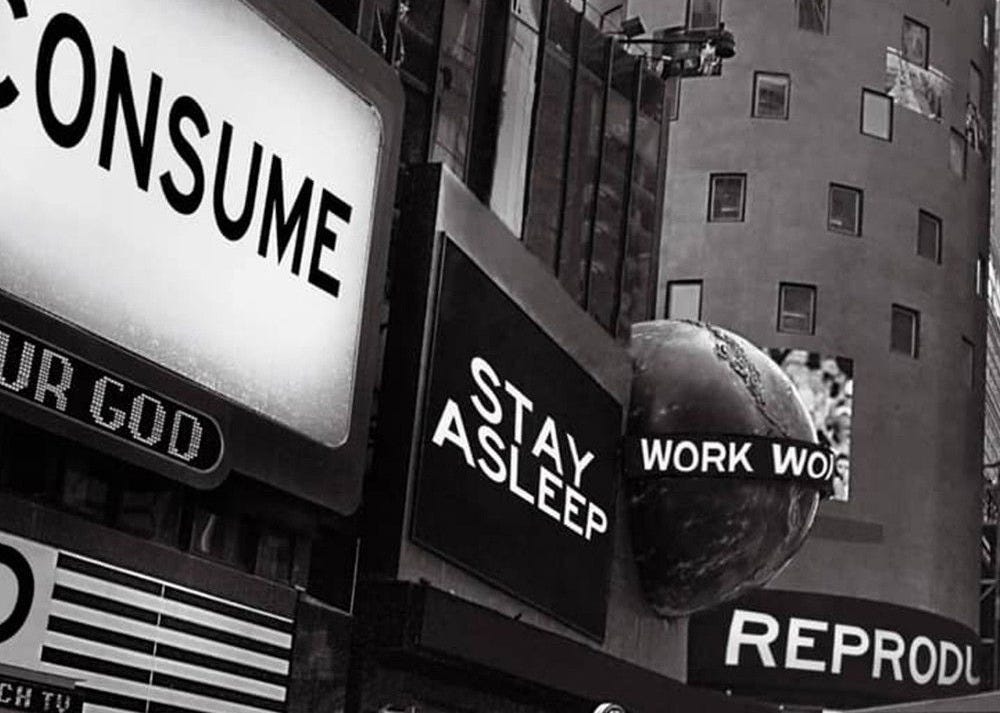
As you drive around town you’ll see signs and logos and buildings; all of these symbols that direct your attention towards something that someone wants you to see. They are all crafted to get you to give something (either attention or money) in exchange for a product or service.
Maybe you don’t drive around, but the same thing is happening all day as you scroll through your social medias. If you haven’t noticed yet, it turns out that the big influencers are not a one-person operation. These big names have entire teams behind them writing their captions, editing their videos, recording content, optimizing their visibility, seeking out collaborations. They are also seeking attention and money.
These attention-grabbers are all funded by organizations.
In organizations, you might know the name of a few of the famous CEOs and influencers, but everyone else mostly remains anonymous. You definitely don’t know the name of the artist, the photographer, the marketing manager, the sales manager, the copywriter, the ad buyer, the assistant. On and on, a list of All the people that had a hand in making the thing you see reach your eyeballs. All of them remain anonymous.
An organization is designed to protect its people from risk. The ones in charge invest many resources to create shields against harm for themselves and their workers. The workers benefit from a kind of anonymity created by the layers of bureaucracy. What also happens is that the leaders end up creating lots of rules and regulations in an effort to protect themselves from the assumed incompetence of the people they hire.
I say ‘assumed incompetence’ because to most organizational leaders that I worked with during my consulting days, a worker is just another person that was hired to do a job and they will eventually mess it up.
The irony is that it might just be all the rules and regulations that create an external scaffolding that prevent people from accessing their inner resources - creativity, clarity, integrity, agility, etc..
It’s a painful paradox that most organizations wrestle with. They grow so fast that they need scaffolding while their people are inhibited from growing because of the bureaucracy.
Every startup has a period where everything is wildly creative and constantly evolving. And just about every one of those that makes it beyond the startup phase is full of people telling stories about how great it used to be.
All the way on the other side of the consciousness pond, there are people trying to create something different. Within this pool you see, more and more, the term organism being used to describe a group of people working on a project, a community, or a transformational training.
For the most part, I see the word organism being used interchangeably with the word organization as a more elevated form of ‘conscious speak’. However, there are some occasions of people who are gathering to work in a way that really feels like something different is happening.
So I started to ask myself, what is the distinction that is trying to emerge here?
While the general structure of an organization is quite clear, that of an organism seems much more difficult to grasp. And maybe that is the perfect place to start.
In the biological world, an organism is not something that can be easily pinned down. On the macro level, a human looks pretty much the same day to day, but on each deeper level of space and time it is an ever evolving, ever moving, ever changing collection of parts whose space-ness and time-ness cannot be accurately predicted.
Neither the whole nor the parts remain static.
There is a sort of ‘lack of safety’ inherent in the nature of being alive.
Decisions must be made.
Risks must be taken.
Every cell dies, eventually, so that a new one can take its place.
Similarly, parts of you that no longer serve the mission are put on the chopping block to be transformed.
At the same time, us humans have created a world for ourselves where we try to do our very best to keep our parts safe.
Not so long ago, I became obsessed with the effects of modern footwear.
Nowadays, common shoes are mostly used as an external scaffold to keep humans from having to use their feet at all in order to walk, run, hike, dance, exercise, and all other movements we choose to make. The shift happened so long ago that most people who use shoes don’t even question their shoe choices beyond what they say about their fashion sense or status. But what all shoes have in common is that they take the risk away from feet having to take on the full responsibility of doing the work.
You will need some kind of support at moments where you are beyond your capacity. It is important to stay aware of when that challenge has ended and you can return to building your inner capacity without external structure.

You might be asking yourself the same question I did back then..
What is the risk of not taking on risk?
What I found in the world of foot health is that people who wore shoes their whole life suffered from foot pain, deformations, inflammation, and other seemingly unrelated health problems. The longer someone has been in shoes, the more they need to be cushioned and supported. It is a vicious cycle. They eventually have trouble moving forward in their life, literally.
What’s true of feet turns out to be true of people and of groups.
The work I do now in helping people transform their inner worlds is very different, but my findings are still the same. People who do not take risks in their life suffer from physical pain and deformations, diseases, depression, burn out, confusion, and lack of direction. They also cannot move forward in their life.
In both cases, there is a lack of INTEGRITY (and flexibility, strength, clarity, etc..).
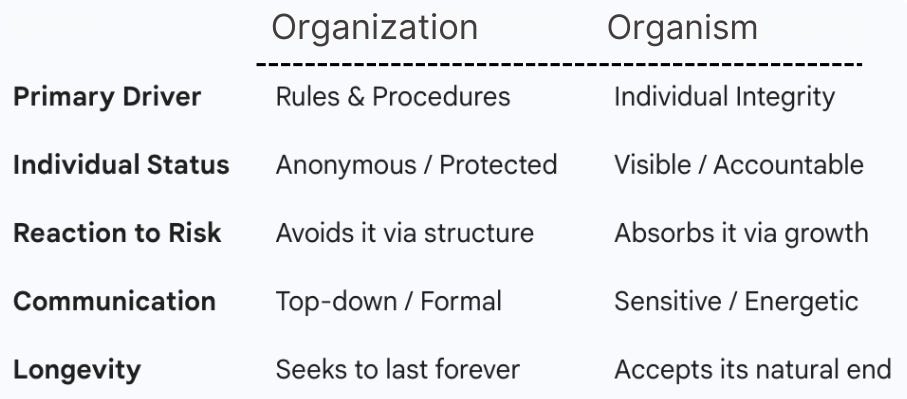
The breakdown above is a clearer picture of the distinction between organism and organization. Here is a risk at putting it into words:
An organism
is internally resourced by the inner structure* of its members.
Decisions arise from people acting inside their integrity.An organization
builds external structure to compensate for a collective lack of inner structure*.
Rules, roles, procedures, and hierarchies do the holding instead of the people.
* inner structure: physical regulation, emotional navigation, energetic sensitivity, mental clarity
Neither of the two is better than the other. They both carry their own costs.
Organisms require:
responsibility beyond just the self
ability to feel and name what’s happening
tolerance for discomfort and endings
Organizations protect from:
inner ambiguity
conflict
personal accountability
existential risk
As you scan the list above it is clear that these two forms point in completely different directions. Organisms point to the responsibility of the individual to hold themselves as a pillar of the group whereas organizations point to the responsibility of the group to hold an umbrella over the individuals.
Is one preferable to the other?
It’s not that simple.
Four years ago I started an online Men’s Group that has met every Tuesday since 2021 (that’s more than 208 meetings!!). At the beginning, and for a very long time, we ran on a set of agreements. I had no idea what I was doing and neither did any of the participants. These things we called ‘agreements’ functioned much more like rules. Men were ongoingly questioned and criticized for breaking the agreements.
At the beginning of our last meeting, now four years later, one of the Men brought up that he believed he had broken one of the agreements by having a state-altering drink an hour before the call started. He asked if anyone had resistance to him staying on the call and we all had a chance to check our internal resistance and respond. I had a small resistance and found that I did not want myself or anyone else to have to be checking on him to see if he was behaving in a way that was dissonant to the space. So, I asked him to keep an eye on himself and let us know if anything felt off. He agreed and nobody else had a resistance after that. No drama. No flogging.
His having brought up his concern opened the space for the group to explore deeper into the qualities of our group that actually led to a lot of my inspiration for writing this article.
The integrity of the Man who brought something none of us would’ve known and the integrity of each Man in the group to check within themselves how they felt about the situation created the possibility of operating as an organism. This is just one example of many experiences that I can point to in how we operate.
What’s possibly even more interesting about this Men’s Group is that in the four years that we’ve been together there has been a lot of turnover. Only two of the Men in the group now are from the original cohort (myself included). Some of them have been part of the group for just several months.
What this tells me is that something else is going on in the transformation we’ve made from organization to organism. I don’t have conclusions about the transformation. I have some big questions about it:
Is there a bigger force that is built in a group that invites more integrity from all who enter?
How many people in a group can hold a high enough level of integrity to create an organismic function?
How do I hold myself when someone is not resourced enough to meet the level of integrity of a group?
What is clear is that when the Men’s Group inhabits the form described above, we are able to have a lot of fun and experience ongoing transformation. Everything that is brought up is an invitation to deepen our connection to ourselves, to the group, and to the world we each interact with.
Why would you have to choose one over the other?
The world we interact with is full of examples of the consequences of organizational numbness. When people are shielded from risk, they are also shielded from the pain of the impact their organization’s decisions have - on the natural world, on humans, and on themselves. I’m talking about things like deforestation, exploitation, extraction, and the other practices that have decimated the Earth.
Yet, in some ways you can’t choose one or the other. Whether you’re an organization or an organism emerges out of the level of the inner integrity held by the members of your group in each instance. The same group can move between these states over time, and even within the same meeting.
For example, NASA is the ultimate organization. They have manuals for everything, rigid hierarchies, layers of safety. They participate in lots of questionable activities. But when the Apollo 13 oxygen tank exploded, the manual became useless. To survive, the crew and ground control had to shift. They had to use integrity (raw honesty about what was failing) and creativity (building a filter out of duct tape and socks) to evolve in real-time. They became an organism for that moment in time.
This answers the question of whether you can point to a group of people as being an organism or an organization. It seems to be more of a dynamic process, where the distinction exist on a moment-to-moment basis. At least that is what I see in groups who are seeking to evolve.
What you can choose is to examine what you really are being, choose if you want to keep being that, and experiment with ways to change the state if it’s not working for you. In a wonderful way, that is already making a shift to a higher level of organism-ness.
Most of us need the support of external structures (organizations) at certain stages of our lives. That need is not a failure.
The only way to get ‘big’ is to go with organizational structure. There are natural limits to how large an organism can grow without external structure. Pretending otherwise is part of the problem.
At the same time, there are natural limits to how alive a group can remain as it grows. External structure has a way of staying long after it is needed. What often goes unnoticed is the moment when scaffolding could be collapsed, and people could be invited back into direct contact with risk, responsibility, and choice.
Most groups who have clearly become large organizations - big companies, governments, associations - seem to have forgotten to check what they really need. As I’ve seen it, the big guys seem to reach a point of no return where the only way out is complete dissolution.
Organisms don’t last forever either.
Individuals die.
Populations go extinct.
Groups complete their arc.
There is no telling how long a group will go on. In either case, organization or organism, there is an end.
This article is no exception.
So here is a simple summary:
Some groups run on rules because people aren’t given the chance to run themselves.
Other groups run on people who can feel when something is working (or not), and act.
Both show up for something.
Both come with costs.
Both reach an end.
And two questions you can take with you:
What must I risk for the organism I’m part of to evolve?
What structures am I using to protect me from risk?